- info@kaizendigitalhub.com
- 151/6 Panthapath Signal, Gazi Tower (2th Floor)

10 Signs Your Business Website Needs a Redesign Before It Costs You Leads
23
Jul
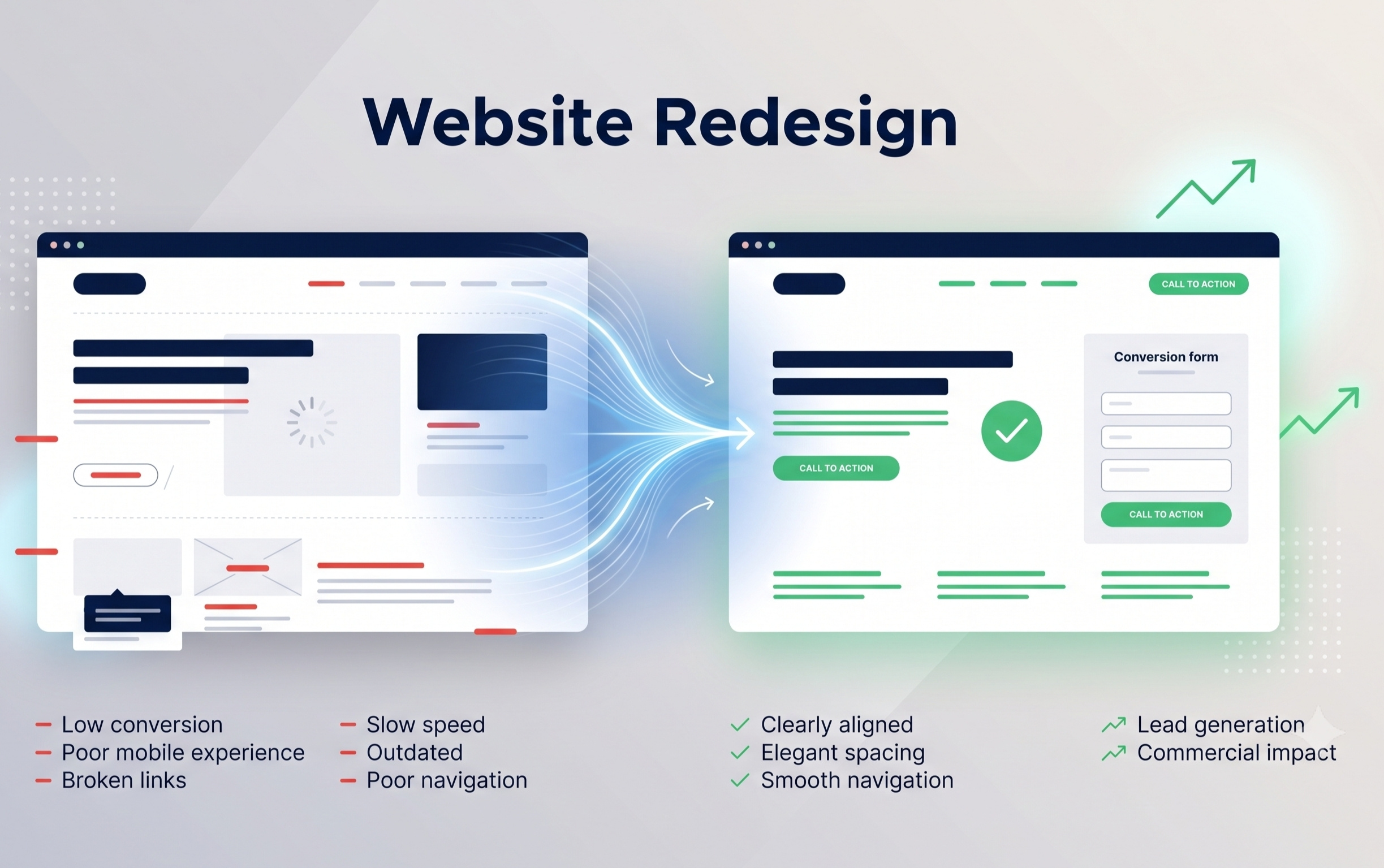
A business website may continue to load, display service information and accept enquiries while still underperforming commercially. The problem is that many website issues develop gradually. Conversion rates decline, mobile users leave, content becomes difficult to manage and competitors create faster, clearer digital experiences.
Management may respond by increasing advertising spend or publishing more content. However, sending additional traffic to an ineffective website can raise acquisition costs without increasing qualified leads.
A website redesign should therefore not be treated as a cosmetic exercise. For a growing business, the decision should be based on lead generation, mobile usability, website speed, trust, search visibility, analytics accuracy and the ability of the platform to support future operations.
Quick answer: Your business website may need a redesign when it attracts traffic without generating enough qualified enquiries, performs poorly on mobile devices, loads slowly, no longer represents the company accurately or prevents your team from publishing and measuring content efficiently. Some problems can be corrected through focused optimisation. Others indicate that the website’s structure, technology and customer journey require a more comprehensive redesign or rebuild.
Website Redesign Warning Signs at a Glance
Warning Sign Likely Business Impact Recommended Response Traffic without conversions Rising acquisition cost Review pages, offers and conversion paths Poor mobile experience Lost enquiries from mobile visitors Responsive UX redesign Slow performance Higher abandonment and weaker engagement Performance and technical review Outdated appearance Reduced trust and credibility Visual and content redesign Confusing navigation Visitors cannot find relevant services Information architecture redesign Business has evolved Website misrepresents the current company Content and structural update Weak SEO structure Important pages fail to rank SEO-led redesign Unreliable analytics Decisions are based on incomplete data Tracking and measurement rebuild Difficult CMS Slow publishing and excessive dependence on developers CMS restructuring or migration Constant technical problems Growing maintenance cost Consider a complete rebuild
The presence of one issue does not automatically justify replacing the entire website. Several connected problems, however, normally indicate that minor corrections will not address the underlying limitations.
1. Your Website Receives Traffic but Generates Too Few Qualified Leads
Website traffic is valuable only when it contributes to a measurable business result.
A company may receive visitors through organic search, social media, paid advertising or referrals and still produce very few enquiries. In that situation, management should not assume that the only solution is to attract more visitors.
The website may fail to explain the offer clearly. Service pages may describe activities without showing the business outcome. Calls to action may be vague, contact forms may request too much information or visitors may not find enough evidence to trust the company.
The problem may also be traffic quality. A page can rank for broad informational queries that attract readers but not potential customers. The redesign process should therefore review both acquisition and conversion.
A useful analysis should compare traffic sources, landing pages, conversion rates and lead quality. Pages receiving strong traffic but weak conversions deserve particular attention because they may already have enough visibility to create commercial value.
The redesign should clarify what the company offers, who it serves, why buyers should trust it and what action the visitor should take next.
2. The Mobile Experience Creates Friction
A website can appear acceptable on a desktop computer and still provide a poor experience on a smartphone.
Common problems include small text, difficult navigation, overlapping elements, forms that are hard to complete and calls to action that disappear below large banners. Buttons may be positioned too closely together, while important content may require unnecessary scrolling.
Mobile usability is especially important for businesses whose customers search while travelling, comparing local providers or responding to advertisements. A customer may discover the company through Facebook, Google Search or a shared WhatsApp link and open the page directly on a phone.
If that visitor cannot understand the service or contact the company efficiently, the marketing investment has been wasted.
A redesign should not simply shrink the desktop layout. It should consider how mobile visitors read, compare information and take action. Contact buttons, forms, service details and proof elements should be prioritised according to the user’s immediate needs.
3. Pages Load Slowly or Feel Unresponsive
Website speed affects more than search visibility. It influences whether visitors remain long enough to understand the offer.
Large images, excessive scripts, poorly configured hosting, third-party widgets and inefficient page builders can make a website feel slow. Even when the page eventually loads, unstable layouts or delayed interactions can create frustration.
The commercial impact can be significant when the company pays for traffic. A business may spend money to generate a click, only to lose the visitor before the landing page becomes usable.
Performance problems should be diagnosed before deciding on a full rebuild. Image optimisation, caching, code improvements and hosting changes may solve isolated issues. However, a website built on an inflexible theme with many conflicting plugins may require a deeper technical redesign.
Businesses should evaluate performance across major page types, including the homepage, service pages, campaign landing pages, blog posts and contact forms. A fast homepage does not compensate for slow pages where conversions actually occur.
4. The Website No Longer Builds Trust
Visitors often evaluate a company before speaking with its sales team.
They review the visual quality of the website, the clarity of its messaging, the professionalism of its team information and the evidence supporting its claims. An outdated design may suggest that the company is inactive, under-resourced or unable to meet modern expectations.
Trust problems are not limited to colours and typography.
The website may display old staff information, expired offers, broken social links, incorrect addresses or services the company no longer provides. It may lack case studies, client examples, testimonials, certifications or clear contact information.
A redesign should create visual consistency and improve the quality of the evidence presented. The objective is not to make the website appear fashionable for a few months. It is to make the company appear credible, capable and relevant to its intended customers.
For a B2B organisation, that may require detailed service pages, leadership information, industry expertise and proof of delivery. For an e-commerce business, trust may depend more heavily on product information, payment security, delivery policies and customer reviews.
5. Visitors Cannot Find the Right Information Quickly
Confusing navigation is often a structural problem rather than a visual one.
As companies grow, they add services, sectors, locations, resources and campaign pages without reconsidering the original website architecture. The navigation becomes crowded, related pages are disconnected and visitors struggle to understand the company’s complete offering.
A potential customer should not need to interpret the organisation’s internal department structure to find a solution.
The website should guide different audiences toward the pages most relevant to their needs. A CEO evaluating a strategic partner requires different information from a customer looking for one specific service. Both journeys should be supported without making the menu unnecessarily complex.
A redesign should review the complete information architecture. This includes navigation, page hierarchy, internal linking, footer structure, breadcrumbs and the relationship between service pages, supporting blogs and future case studies.
The objective is to help both users and search engines understand which pages are most important and how the content fits together.
6. The Website No Longer Reflects the Current Business
A company may launch with a limited range of services and later enter new markets, introduce new products or target larger customers.
The website often fails to keep pace.
A business that now provides strategic consulting, analytics and development may still appear to offer only basic social media services. Another company may have moved from small local projects to enterprise contracts but continue using messaging written for an early-stage audience.
This creates a positioning problem. Prospective customers cannot evaluate capabilities that the website does not explain.
The redesign process should begin with the current business model rather than the existing pages. Management should clarify which services generate the most value, which customers the company wants to attract and how the brand should be positioned during the next stage of growth.
The resulting website structure should support both current priorities and planned expansion. It should also leave room for future service pages, case studies, industry pages and supporting content without requiring another structural redesign within a short period.
7. The Website Structure Limits SEO Growth
Publishing more blog posts will not solve every SEO problem.
A website may have useful content but lack strong commercial pages. Several pages may compete for the same keyword, while important services remain buried within generic descriptions. Internal links may be inconsistent, and the URL structure may not reflect the relationship between services and supporting content.
Technical problems can also limit visibility. Search engines may encounter duplicate pages, broken links, incorrect redirects, unnecessary indexable URLs or weak metadata.
An SEO-led redesign should begin with keyword mapping and page purpose. Broad commercial keywords should normally support primary service pages. Cost, comparison, checklist and problem-aware keywords can support cluster blogs that link back to those services.
Businesses facing structural search problems can review Kaizen Digital Hub’s SEO services in Bangladesh before redesigning the website without an organic-search plan.
SEO should be involved before page URLs, navigation and templates are changed. Redesigning first and reviewing SEO after launch can result in lost rankings, broken links and unnecessary recovery work.
8. Analytics Cannot Explain What Visitors Are Doing
Management should be able to determine which pages attract visitors, which channels generate enquiries and where users leave the conversion journey.
Many business websites cannot provide those answers.
Analytics may be missing, incorrectly configured or disconnected from important conversion actions. Contact forms may generate email notifications without recording a conversion. Telephone calls, WhatsApp clicks, bookings and downloads may not be tracked at all.
A redesign creates an opportunity to define measurement before the new website is launched.
The tracking plan should identify meaningful actions, not every possible click. For a service company, these may include consultation requests, qualified forms and phone calls. For an e-commerce business, they may include product views, checkout activity, purchases and revenue.
Companies requiring stronger reporting can connect the redesign with Kaizen Digital Hub’s data analysis services in Bangladesh.
A more attractive website cannot be evaluated properly when management lacks reliable baseline and post-launch data.
9. Your CMS Prevents Efficient Publishing and Updating
A content management system should help the company maintain the website without creating unnecessary operational delays.
Problems arise when employees cannot update services, publish articles or change basic page information without developer support. Content may be stored inside rigid templates, while small changes risk breaking the layout.
The organisation may also depend on an unsupported plugin, outdated framework or custom system that only one developer understands.
These limitations increase the cost of every future campaign. A landing page that should take two days may require several weeks because the CMS cannot support the required design or tracking.
A redesign should consider the people responsible for maintaining the website after launch. Editors need appropriate controls, while design and brand consistency should still be protected.
The correct platform depends on the company’s requirements. A service website, publication, online store and web application should not automatically use the same technical solution.
10. Maintenance Problems Are Becoming More Expensive
Frequent website problems may indicate that the existing platform has reached the end of its useful life.
The company may experience recurring plugin conflicts, security concerns, broken layouts and compatibility issues. Developers may spend increasing amounts of time correcting temporary problems without improving the customer experience.
At this stage, continued patching can become more expensive than rebuilding the website on a cleaner foundation.
Management should compare the cost of maintaining the current system with the cost and expected value of replacement. The comparison should include lost leads, internal delays, developer fees, security risks and missed campaign opportunities.
Businesses experiencing several of these issues can explore Kaizen Digital Hub’s website redesign services before committing more resources to short-term repairs.
Website Redesign vs Website Rebuild
A redesign and a rebuild are related but not identical.
A redesign normally updates the user experience, visual system, content structure and conversion journey while retaining some of the existing technical foundation.
A rebuild replaces a significant part of the underlying platform, codebase, templates or CMS. It may also involve a new information architecture and data structure.
Website Condition Redesign May Be Enough Rebuild May Be Better Branding is outdated Yes Not normally required Navigation is confusing Yes Required if architecture is severely limited Website is slow Possibly When the platform prevents optimisation CMS is difficult to use Possibly When workflows cannot be improved Integrations regularly fail Limited Often necessary Security and maintenance risks are increasing Limited Frequently appropriate SEO structure is weak Yes, with migration planning When URLs and templates require major change Business model has changed completely Possible Often more efficient
The decision should follow a technical, content and conversion audit. Rebuilding a website unnecessarily can increase cost and migration risk. Redesigning a fundamentally weak system can preserve the same limitations inside a new visual interface.
How to Prepare for a Website Redesign
A website redesign should begin with evidence.
Management should review current traffic, conversions, search visibility, user behaviour, sales feedback and content performance. The company should identify which pages generate business value and which pages create confusion.
The redesign brief should define the target audience, primary services, conversion actions, required integrations and future content structure. It should also document account ownership, hosting access, analytics and third-party systems.
Content should be planned before templates are finalised. Designing pages without knowing what they must communicate often creates layouts that prioritise appearance over business clarity.
The company should also create an SEO migration plan before launch. Existing URLs, rankings, metadata and internal links must be reviewed so that valuable visibility is not lost when the new structure becomes active.
How Kaizen Digital Hub Approaches Website Redesign
Kaizen Digital Hub treats website redesign as a business-performance project rather than a visual refresh.
The initial review considers the website’s conversion paths, mobile usability, performance, content, SEO structure, analytics and technical limitations. The objective is to determine which problems can be corrected and which require a broader redesign or rebuild.
A project may involve revised service pages, stronger calls to action, a new content hierarchy, mobile optimisation and improved tracking. More complex websites may require CMS migration, custom development, e-commerce improvements or integration with other business systems.
Companies seeking an experienced web development company in Bangladesh can work with Kaizen Digital Hub to connect strategy, design, development, SEO and measurement within one redesign process.
The resulting website should not only look more professional. It should be easier to manage, more credible to buyers and better equipped to generate measurable business outcomes.
Final Verdict
Your website does not need a redesign simply because its appearance is several years old.
A redesign becomes commercially important when the website loses leads, creates mobile friction, weakens trust, limits SEO or prevents the company from publishing and measuring content efficiently.
Some businesses need targeted optimisation. Others require a complete rebuild because the existing CMS, structure and code can no longer support growth.
The correct decision should be based on evidence, future requirements and the total cost of continuing with the current system.
Request a Website Review from Kaizen Digital Hub to assess your website’s lead generation, mobile experience, speed, SEO structure, analytics and technical limitations.
Frequently Asked Questions
How often should a business website be redesigned?
There is no fixed redesign schedule. The decision should depend on performance, business changes, customer expectations and technical condition rather than the age of the website alone.
Does an outdated website affect sales?
It can. Visitors may leave when the website appears untrustworthy, performs poorly on mobile devices or fails to explain the offer clearly. The effect should be measured through conversions, lead quality and sales feedback.
Should we redesign the website or build a new one?
A redesign may be sufficient when the underlying CMS and code remain reliable. A rebuild may be more appropriate when the platform creates security, performance, integration or content-management limitations.
Can a redesign improve SEO?
Yes, when SEO is included during planning. Better structure, content, internal linking and performance can support visibility. An unmanaged migration can also damage existing rankings, so redirects and URL changes must be planned carefully.
Why did website leads decline even though traffic increased?
The new traffic may have weak commercial intent, or the website may not convert visitors effectively. Review landing pages, traffic sources, calls to action, form completion and lead quality before increasing acquisition spending.
How long does a website redesign take?
The timeline depends on website size, content readiness, integrations, approval speed and whether the project involves redesigning or rebuilding the platform. A clear scope and decision process reduce delays.
What should a website review include?
A professional review should evaluate user experience, mobile performance, conversion paths, speed, SEO, content, tracking, CMS limitations, security and future business requirements.