- info@kaizendigitalhub.com
- 151/6 Panthapath Signal, Gazi Tower (2th Floor)

E-commerce Website Checklist for Bangladesh Businesses
23
Jul
An e-commerce website can look professional and still fail commercially. Customers may abandon the checkout, online payments may not update order statuses correctly, inventory may become inaccurate and courier teams may need to re-enter every order manually.
These problems are particularly costly for businesses in Bangladesh, where an online store may need to manage digital payments, cash on delivery, address variations, delivery zones, courier reconciliation and frequent customer confirmation through phone or messaging channels.
Successful e-commerce website development should therefore begin with the complete order journey rather than the homepage design. The website must help customers discover the right product, understand its value, complete an order easily and receive accurate delivery information. At the same time, the business needs reliable controls for inventory, payments, fulfilment, returns, reporting and customer data.
Quick answer: Before launching an e-commerce website in Bangladesh, confirm that the platform supports mobile-first shopping, accurate product data, online payments and cash on delivery, courier integration, inventory synchronisation, secure checkout, product SEO, analytics and complete pre-launch testing. The strongest website is not necessarily the one with the most features. It is the one that processes orders accurately and supports profitable growth.
E-commerce Development Checklist at a Glance
Development Area What Must Be Confirmed Business Risk if Missing Business requirements Products, markets, fulfilment and growth plans Expensive redevelopment Platform selection Scalability, integrations and ownership Technical limitations Product catalogue Variations, SKUs, prices and stock Incorrect orders Mobile experience Navigation, product pages and checkout Lost mobile sales Online payments Gateway, validation and reconciliation Failed or unverified payments Cash on delivery Confirmation and delivery controls Fraudulent orders and returns Courier operations Rates, zones, tracking and API workflow Manual processing delays Inventory Real-time stock and low-stock controls Overselling Product SEO Categories, content and structured data Weak organic visibility Security Access, updates, backups and payment handling Data and operational risk Analytics Revenue and checkout tracking Unreliable decisions Pre-launch QA End-to-end order testing Customer-facing failures
The checklist should be treated as an operational plan. Design, development, logistics and marketing decisions must support the same commercial process.
1. Define the Business Model Before Selecting Technology
The first step is documenting how the business will sell and fulfil orders.
A company selling twenty standard products has different requirements from a fashion retailer managing colours, sizes and seasonal stock. A marketplace connecting several sellers requires a substantially more complex system than a single-vendor online store.
Management should define the target locations, average order value, expected monthly volume, payment methods, delivery model, return process and responsible internal teams. The development team should also understand whether the business plans to add wholesale pricing, subscriptions, loyalty programmes, mobile applications or international sales later.
Without this planning, businesses often select a platform because it appears affordable during launch. They later discover that essential inventory, courier or reporting functions require custom development.
The website specification should prioritise the capabilities needed during the next two or three years rather than only the features required on launch day.
2. Choose the Right E-commerce Platform
The platform determines how easily the business can manage products, integrate services and scale operations.
A hosted platform may provide faster setup and controlled maintenance. An open-source content management system can provide greater flexibility but requires responsible hosting, updates and security management. A custom platform may be suitable when the business has specialised fulfilment, pricing or integration requirements that standard systems cannot support efficiently.
The decision should consider ownership, recurring costs, available developer expertise, integration capability and upgrade requirements.
Management should ask whether the platform can support:
- The expected number of products and variations
- Bangladesh payment-gateway integration
- Courier and order-management workflows
- Inventory synchronisation
- Product and category SEO
- Discounts, coupons and promotional rules
- Analytics and advertising tracking
- Future mobile-app or ERP integration
A familiar platform is not automatically the correct choice. The platform should be selected from the operating requirements, not the developer’s personal preference.
3. Design a Scalable Product Catalogue
Product data should be structured before hundreds of items are uploaded.
Every product needs a clear name, SKU, category, price, inventory status, description, images and relevant attributes. Products with colour, size, weight, storage or other variations require consistent variation rules.
The SKU structure should help employees identify products and variations quickly. Two visually similar items should not use confusing or duplicated identifiers.
The catalogue should also define which information is required for each product category. A clothing product may need size, fabric and care details. Electronics may require model, specification, warranty and compatibility information. Grocery items may require weight, ingredients, storage instructions and expiry information.
Poor catalogue planning creates duplicate products, inconsistent filters and inaccurate orders. Correcting those problems after launch becomes increasingly difficult as order history and search visibility grow.
4. Create Clear Categories, Navigation and Search
Customers should be able to find products without knowing how the company organises inventory internally.
Categories should reflect customer intent. A store should avoid creating several nearly identical categories simply because its internal departments use different terminology.
The main navigation should prioritise commercially important categories, offers and support information. Filters should help customers narrow products by useful attributes such as size, price, brand, colour, availability or specification.
Site search should recognise common product names, model numbers and reasonable spelling variations. A search returning no results should suggest categories or related products instead of ending the shopping journey.
Navigation also affects SEO. Important categories should be reachable through normal internal links, and the website should avoid generating thousands of low-value filter URLs that search engines can crawl unnecessarily.
5. Build for Mobile Shopping First
Many customers will discover the store through mobile search, Facebook, Instagram, messaging apps or digital advertisements. The mobile experience cannot be treated as a reduced version of the desktop design.
Product images, pricing, variation selectors and calls to action should remain clear on smaller screens. Customers should be able to add products, update quantities and complete checkout without excessive zooming or scrolling.
Mobile forms should use appropriate input types for telephone numbers, email addresses and numeric fields. Error messages should explain exactly what needs to be corrected without deleting information the customer has already entered.
The development team should test the store on affordable and mid-range Android devices as well as premium phones. A website that works only on a fast device and connection does not represent the complete Bangladesh customer base.
6. Create Product Pages That Support Buying Decisions
A product page should answer the customer’s important questions before checkout.
The page should include accurate photographs, a clear price, availability, selectable variations, delivery expectations, return information and a persuasive description. Technical products may require specification tables, while fashion and lifestyle products may benefit from size guides and contextual images.
The product description should explain the use case and relevant differences rather than repeating generic manufacturer copy.
Trust elements must also be genuine. Businesses should not display fictional ratings, false scarcity or misleading discount information. These tactics may produce short-term clicks while weakening customer confidence and increasing complaints.
Related products, bundles and complementary items can increase average order value when the recommendations are genuinely useful. They should not distract customers from completing the primary purchase.
7. Prepare Product and Category SEO
Product SEO should be included during development rather than added after thousands of pages have been published.
Every important category needs a unique purpose, readable URL, optimised title and useful introductory content. Product pages should contain accurate names, descriptions, images, availability and variation information.
Google recommends using Product and Offer structured data on pages where customers can purchase products. Eligible merchant listings may present details such as price, availability, shipping and return information in search experiences. Product markup should focus on individual products or variations rather than broad category pages.
The store should also define canonical URLs, pagination behaviour and indexation rules for filters, searches and out-of-stock items. Deleting unavailable products immediately can waste accumulated search visibility when the item may return.
Google states that structured data, product feeds and a clear e-commerce site structure can help it understand product information and discover important pages. Businesses can also use Google Merchant Center to provide product data for eligible shopping experiences.
Businesses that need an organic acquisition plan alongside development can explore Kaizen Digital Hub’s e-commerce SEO services in Bangladesh.
8. Maintain Accurate Pricing and Inventory
A customer should not be able to order an unavailable item or see one price on the product page and another during checkout.
The website needs a defined source of truth for stock. For a small business, that may be the e-commerce platform. A larger organisation may need synchronisation with an ERP, warehouse system, point-of-sale system or marketplace inventory.
Stock should be managed at the variation level. A product may be available in black but unavailable in blue, or available in one size but not another.
The system should also define how cancelled, failed and returned orders affect stock. Reserving inventory indefinitely for abandoned orders can make products appear unavailable. Releasing stock too early can cause overselling.
Promotional pricing requires similar control. The website should show when a discount begins and ends, whether coupons can be combined and which products are excluded.
9. Support Online Payments and Cash on Delivery
Bangladesh businesses frequently need both digital payment and cash-on-delivery options.
Gateway selection should consider supported payment channels, settlement procedures, transaction fees, refund processes, technical documentation and merchant support. The development team should also confirm how successful, failed, cancelled and pending transactions are reported to the website.
Providers such as SSLCOMMERZ and shurjoPay publish integration resources for developers. SSLCOMMERZ supports merchant APIs and payment notifications, while shurjoPay provides plugins, APIs and a sandbox environment for testing before production. Merchant onboarding requirements and commercial terms should be confirmed directly with the selected provider.
The website should never mark an order as paid only because the customer returns to a success page. The server should verify the transaction through the gateway’s approved validation or notification process.
Cash on delivery also requires controls. The business should decide whether every product and location qualifies for COD, whether high-value orders require advance payment and how suspicious or repeated failed orders will be reviewed.
Order confirmation through SMS, phone or messaging may reduce avoidable returns, but it should be designed as an efficient workflow rather than an entirely manual process.
10. Simplify the Checkout Experience
Checkout should request only the information required to process and deliver the order.
A Bangladesh checkout normally needs the customer’s name, valid telephone number, delivery address, area or zone, payment method and order confirmation. Additional fields should be included only when they support fulfilment, invoicing or legitimate operational requirements.
Guest checkout is generally appropriate for stores where forcing account creation would add unnecessary friction. Customers can be offered the option to create an account after placing the order.
Delivery fees, discounts and final totals should appear before the customer confirms the purchase. Unexpected charges at the final step can increase abandonment and support complaints.
The checkout should preserve customer information when a validation error occurs. It should also prevent duplicate orders when a customer presses the confirmation button several times.
11. Integrate Courier and Delivery Workflows
Courier operations should be planned as part of development, not handled as an after-launch spreadsheet process.
The system should calculate or display delivery charges according to the business’s service zones. Dhaka metropolitan delivery, nearby areas and nationwide delivery may have different rates, timelines and COD conditions.
Courier integrations can reduce manual data entry by transferring order information from the website to the merchant system. Pathao, for example, provides a courier merchant system and developer API, and publicly promotes COD delivery services for merchants in Bangladesh. The exact zones, charges, operational rules and API capabilities should be confirmed during implementation.
The website and admin system should record the courier, consignment identifier, dispatch status, delivery status and return status.
The business also needs a reconciliation process. A delivered COD order is not complete from an accounting perspective until the collected amount, courier charge and settlement are verified.
12. Create an Order-Management Workflow
Customers see one order, but the business may process several operational stages.
A practical workflow may include new order, payment pending, confirmed, processing, packed, dispatched, delivered, cancelled and returned. Each status should have a clear meaning and responsible team.
The platform should prevent employees from using statuses inconsistently. For example, “completed” should not sometimes mean dispatched and sometimes mean delivered.
Customers should receive useful notifications at appropriate stages without being overwhelmed. A confirmation message should include the order number, products, total and next expected step.
Employees need an admin view that allows them to search orders by order number, customer name, telephone number, payment status and delivery reference.
13. Define Cancellation, Return and Refund Processes
Return and refund policies must be written before checkout and fulfilment logic is finalised.
The business should define which products can be returned, the applicable period, acceptable product condition and who pays return delivery charges. Perishable, customised or hygiene-sensitive products may require different policies from standard consumer goods.
Digital-payment refunds require a documented operational process. The website team, finance team and payment provider must understand how refunds are initiated, recorded and communicated to customers.
Cancelled and returned orders should also update inventory and reporting correctly. Otherwise, management may overstate sales while stock remains unavailable inside the system.
Policy pages should be easy to locate from product pages, checkout and the website footer. The final language should be reviewed according to the company’s products and legal obligations.
14. Protect Customer and Payment Data
E-commerce security is a continuous operational requirement.
The website should use HTTPS, secure administrative access, strong passwords, appropriate permissions, regular updates, backups and monitoring. Employees should receive only the access needed for their responsibilities.
OWASP’s Application Security Verification Standard provides developers with requirements for testing technical security controls, while the OWASP Top 10 identifies major web-application risk categories that development teams should consider.
Businesses should avoid storing card information unless they have the specialised compliance capability to do so. The PCI Security Standards Council explains that merchants outsourcing payment processing may have a reduced compliance scope, but they still retain security and validation responsibilities for their own e-commerce environment.
Backups should be tested, not merely scheduled. A backup that cannot restore products, customers and orders does not protect the operation.
15. Optimize Website Speed and Stability
Product images, marketing scripts and third-party integrations can make e-commerce websites slow.
Images should be appropriately compressed and delivered in modern formats. Scripts should be reviewed so that advertising tags, chat tools and widgets do not unnecessarily block the shopping experience.
Performance should be tested on product pages, category pages, cart and checkout—not only on the homepage.
Google’s Core Web Vitals measure loading performance, responsiveness and visual stability. Its current guidance identifies good user-experience targets of an LCP within 2.5 seconds, INP below 200 milliseconds and CLS below 0.1 at the 75th percentile.
The development team should also test traffic spikes caused by promotions. A store that becomes unavailable during its largest campaign can lose revenue and advertising investment simultaneously.
16. Implement Revenue and Funnel Tracking
Traffic reports alone cannot explain whether the store is profitable.
Analytics should capture product views, product selections, add-to-cart actions, checkout progress, purchases, revenue, coupons and refunds where technically appropriate. Advertising platforms should receive only accurate and approved conversion data.
Management should be able to compare:
Measurement Business Question Product conversion rate Which products turn visits into orders? Cart abandonment Where do customers stop? Payment success rate Are gateway failures reducing sales? COD confirmation rate How many COD orders are genuine? Delivery success rate How many dispatched orders are delivered? Return rate Which products or locations generate returns? Customer acquisition cost What does a new customer cost? Contribution per order Is the order profitable after fulfilment costs?
Platform-reported revenue should be reconciled with payment, courier and order data. An order placed is not always an order delivered, and an attributed sale is not always collected revenue.
Businesses requiring connected dashboards and attribution can explore Kaizen Digital Hub’s data analysis services in Bangladesh.
17. Make the Admin System Operationally Useful
The admin interface must support the employees who will run the business after launch.
Product teams need controlled ways to update prices, stock and content. Order teams need fast search and status controls. Finance teams may require payment and settlement reports, while management needs reliable revenue and operational summaries.
Permissions should be assigned by role. A content editor may not need access to payment configuration, and a courier operator may not need permission to change product prices.
The platform should also record important administrative changes where possible. When a price, stock level or order status changes unexpectedly, the business should be able to identify what happened.
Documentation and training should be included in the handover. A website is not complete when only the developer knows how to operate it.
18. Complete Pre-launch Quality Assurance
Every major customer and administrative journey should be tested before launch.
Testing should include different products, variations, coupons, addresses, payment methods, devices and delivery zones. The team should place real or controlled test orders and follow them through payment, inventory, courier creation, fulfilment, notification and reporting.
The pre-launch test should cover:
- Successful, failed and cancelled online payments
- Cash-on-delivery orders
- Out-of-stock products and variations
- Coupon and discount rules
- Dhaka and nationwide delivery charges
- Customer emails or messages
- Refund and cancellation workflows
- Analytics and advertising events
- Mobile checkout
- Admin roles and access
- Backup and restoration
- Redirects, metadata and XML sitemaps
Google recommends verifying site ownership, submitting a sitemap for larger sites and monitoring indexing after an e-commerce launch. Merchant Center and product structured-data reports should also be reviewed after deployment.
A launch checklist should identify the person responsible for each test and record whether the issue has been resolved.
Red Flags Before Approving Development
Businesses should reconsider a proposal when the developer focuses entirely on the homepage while ignoring inventory, courier operations and payment validation.
Other warning signs include unclear account ownership, no staging environment, missing backup planning and an inability to explain how failed payments or returned orders will be handled.
A very low quotation may exclude product entry, payment-gateway integration, courier workflows, tracking, testing or post-launch support. These exclusions are not automatically unreasonable, but they must be visible before the project begins.
Companies comparing providers should read how to choose a digital marketing agency in Bangladesh before approving access, ownership and reporting arrangements.
How Kaizen Digital Hub Approaches E-commerce Development
Kaizen Digital Hub begins with the transaction and fulfilment model rather than applying the same store template to every business.
The discovery process considers product structure, customer locations, payment options, COD controls, courier operations, inventory, content, search visibility and reporting requirements.
A small catalogue may require a streamlined platform and simple fulfilment process. A growing retailer may need advanced variations, product feeds, warehouse coordination and marketing integrations. A larger business may require custom development, ERP connectivity or a mobile application.
Kaizen’s ecommerce website development in Bangladesh connects customer experience with the operational systems required to process orders accurately.
Businesses seeking broader technical capability can also work with Kaizen as an ecommerce website development company in Bangladesh for strategy, UX, development, integrations, SEO and analytics.
The goal is not merely to launch an online shop. It is to create a reliable commerce system that supports customer acquisition, fulfilment and profitable growth.
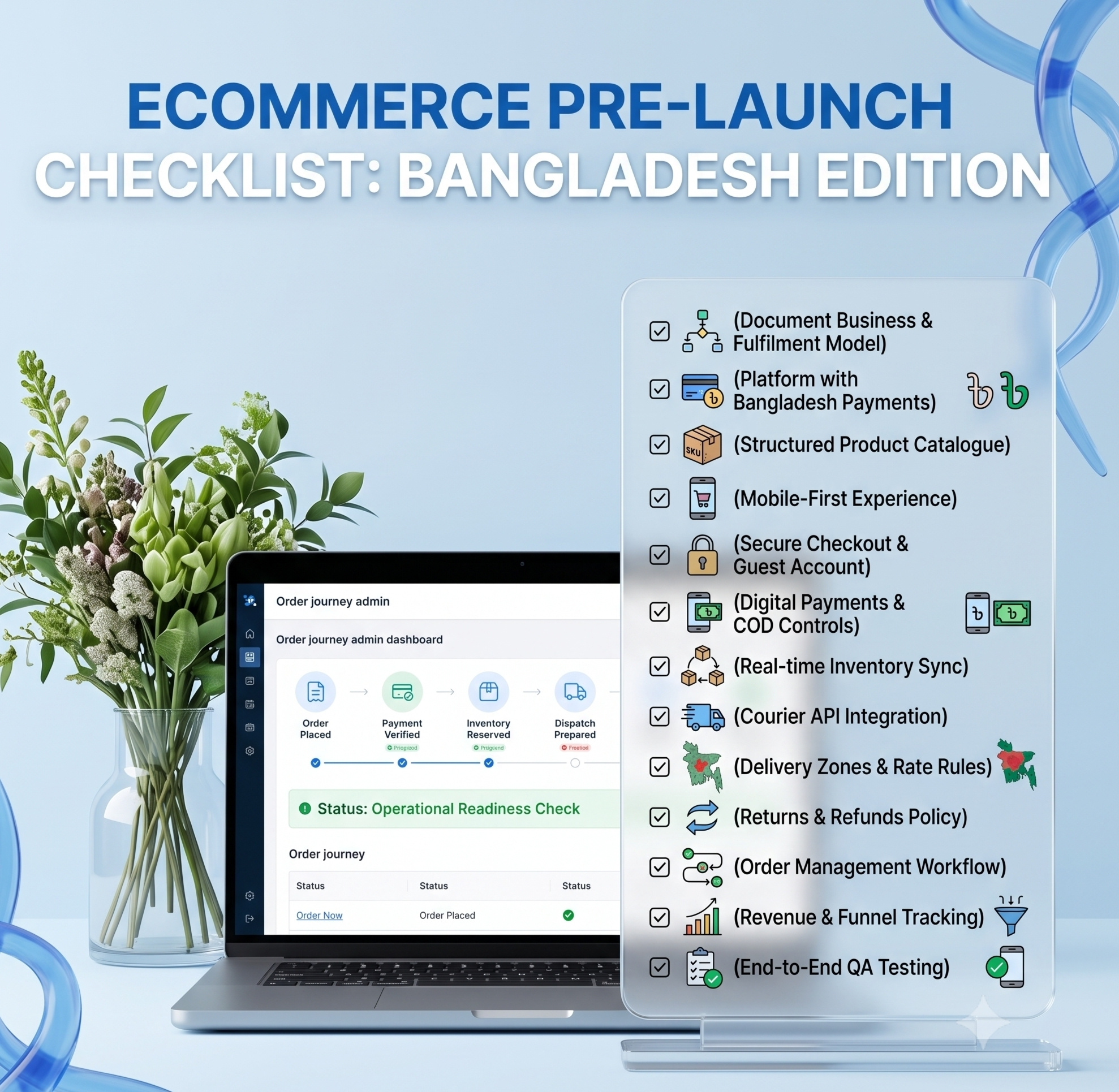
Final E-commerce Website Checklist
Before launch, confirm that the website has:
- A documented business and fulfilment model.
- A platform capable of supporting future requirements.
- Structured product, variation and SKU data.
- Clear categories, filters and site search.
- A mobile-first shopping experience.
- Complete and persuasive product pages.
- Product SEO and valid structured data.
- Accurate pricing and inventory controls.
- Verified online-payment and COD workflows.
- A short and transparent checkout.
- Courier, tracking and reconciliation processes.
- Consistent order statuses and notifications.
- Published cancellation, return and refund policies.
- Secure access, updates and tested backups.
- Acceptable speed across product and checkout pages.
- Revenue and funnel tracking.
- A practical admin system with appropriate permissions.
- Successful end-to-end pre-launch testing.
A store should not launch simply because the visual design is complete. It should launch only after the business can accept, verify, fulfil, track and reconcile orders reliably.
Discuss Your E-commerce Project with Kaizen Digital Hub to review your products, payment requirements, courier workflow, inventory and expected growth.
Frequently Asked Questions
What should an e-commerce website in Bangladesh include?
It should include mobile-friendly product discovery, accurate product data, secure online payments, cash on delivery, delivery-zone controls, courier workflows, inventory management, order tracking, product SEO and conversion analytics.
Which payment gateway should a Bangladesh e-commerce business use?
The correct provider depends on payment channels, onboarding requirements, settlement, fees, refund support, integration quality and merchant service. Businesses should compare approved providers and verify current commercial terms directly.
Is cash on delivery still necessary?
COD may remain commercially important for businesses whose customers prefer payment at delivery. The business should control order confirmation, service areas, high-value orders and return-to-origin risk rather than enabling COD without conditions.
Should courier integration be automated?
Automation becomes valuable when manual order entry consumes time or creates errors. Smaller stores may begin with a controlled manual process, while growing stores should consider API or system integration.
How long does e-commerce website development take?
The timeline depends on product volume, content readiness, design complexity, payment onboarding, courier integration and custom functionality. Product preparation and operational approvals often affect the timeline as much as coding.
Does an e-commerce website need SEO before launch?
Yes. Category structure, URLs, product data, metadata, structured data and indexation rules should be planned during development. Correcting a poor catalogue structure after launch can be expensive.
Should we use a template or custom development?
A template-based platform may be appropriate for standard requirements and controlled budgets. Custom development is more suitable when fulfilment, pricing, inventory or integration requirements cannot be supported efficiently by standard solutions.
What should be tested before launch?
The team should test product variations, stock, discounts, payments, COD, delivery fees, notifications, courier processing, refunds, analytics, mobile checkout, security and backups.