- info@kaizendigitalhub.com
- 151/6 Panthapath Signal, Gazi Tower (2th Floor)

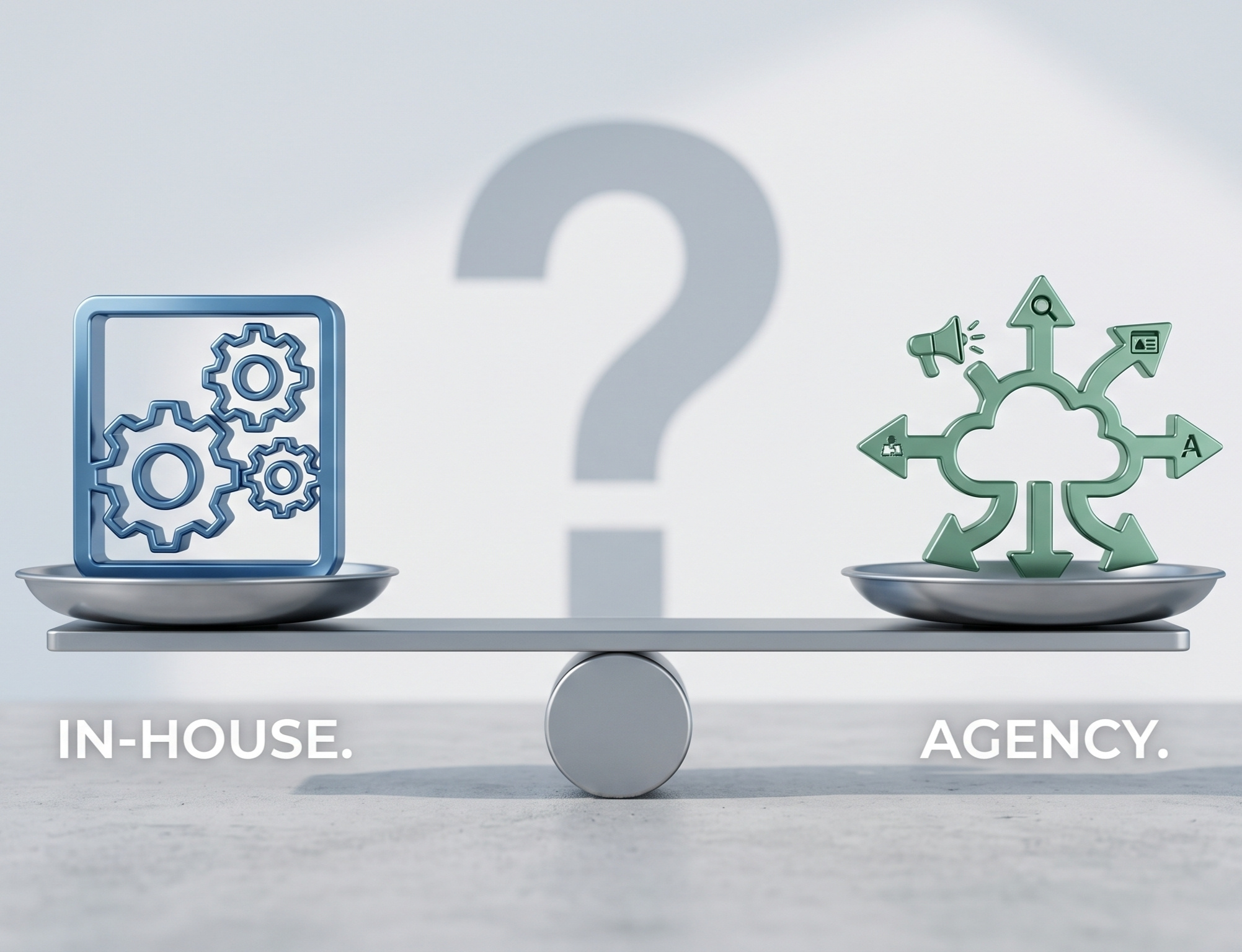
In-House Marketing vs Agency in Bangladesh
23
Jul
Choosing between an in-house marketing team and a digital agency is not simply a comparison between salaries and monthly retainers. It is a decision about how your business will access specialist expertise, manage execution, respond to market opportunities and remain accountable for commercial outcomes.
An internal employee may understand the company’s products, culture and approval process more deeply than an external provider. An agency, however, can provide access to SEO specialists, advertising managers, designers, developers, analysts and strategists without requiring the company to recruit each role separately.
For businesses evaluating in-house marketing vs agency in Bangladesh, the correct structure depends on campaign complexity, internal management capacity, budget, required speed and the number of specialist capabilities needed.
Quick answer: An in-house team is generally more suitable when marketing is a permanent core function requiring daily coordination, deep institutional knowledge and direct operational control. An agency is generally more suitable when the company needs broader specialist coverage, faster execution or flexible capacity without building an entire department. Many established businesses benefit most from a hybrid model in which an internal marketing lead owns strategy and an agency provides specialised execution.
In-House Marketing vs Agency at a Glance
Decision Area In-House Marketing Team Digital Marketing Agency Initial setup Recruitment, onboarding and system development Discovery, contract and account setup Monthly cost Salaries, benefits, software, equipment and management Retainer, project fees and agreed extras Specialist coverage Limited by team size and recruitment budget Access to several specialist disciplines Brand knowledge Usually stronger over time Requires structured onboarding and communication Speed to build capability Can take several months Existing team may begin faster Direct control High Shared through scope and approval processes Scalability Requires hiring or outsourcing Capacity may expand through a revised scope Continuity risk Employee turnover and individual dependency Agency team changes and provider dependency Best suited for Companies with continuous internal workloads Companies needing specialist or multi-channel support Hybrid potential Can manage agency partners Can complement internal leadership
This table provides an initial comparison, but the decision should be based on the complete operating cost and the capability the company must maintain.
The Real Cost of an In-House Marketing Team in Bangladesh
The visible cost of an internal team is its monthly payroll. The actual cost is wider.
A company may need a marketing manager, digital marketing specialist, SEO specialist, designer, content professional, advertising manager, web developer or data analyst. One employee may cover several responsibilities in a small business, but combining too many specialist functions often reduces the quality and depth of execution.
Salary Costs
Current salary data for Dhaka illustrates how quickly the payroll requirement can grow.
Glassdoor currently reports a total monthly pay range of approximately BDT 55,000–130,000 for marketing managers in Dhaka. Its reported range for digital marketing specialists is approximately BDT 21,000–56,000 per month, while SEO specialists are shown around BDT 22,000–53,000. Graphics designers have a reported range of approximately BDT 21,000–33,000 per month. These are survey-based estimates rather than fixed salary standards, and actual compensation depends on experience, company size and responsibilities.
Using those ranges, a four-person team consisting of a marketing manager, digital marketer, SEO specialist and designer could require approximately BDT 119,000–272,000 in base monthly compensation before additional employment expenses.
That team may still require external help for video production, advanced website development, analytics implementation, photography, public relations or high-volume content production.
A company should therefore avoid comparing the salary of one junior employee with the cost of an agency team providing several different disciplines.
Recruitment and Onboarding Costs
Recruitment consumes management time before the employee begins producing useful work.
The company must prepare job descriptions, advertise roles, review applications, conduct interviews and assess practical skills. Senior staff may need to participate in several recruitment rounds.
After hiring, the employee needs access to company systems, products, previous campaigns, brand guidelines and performance data. A new marketing manager may understand the business quickly but still require time to build a team and establish reliable processes.
A failed hire creates additional cost. The company may spend several months on recruitment and onboarding before restarting the entire process.
Software and Technology Costs
A professional internal team requires more than email and social media access.
The technology stack may include collaboration software, design tools, SEO platforms, advertising research, analytics, reporting, automation, CRM and project management.
For perspective, Google currently lists the flexible Business Starter edition of Workspace at USD 8.40 per user per month. Semrush lists its SEO Toolkit Pro plan at USD 139.95 per month, while HubSpot Marketing Hub Professional starts around USD 800 per month before possible additional seats, contacts and onboarding costs. Exact Bangladesh billing, taxes and currency conversion may vary.
Not every business needs premium versions of every platform. However, software cost should appear in the internal-team budget rather than being treated as an invisible operational expense.
The company may also need computers, storage, backup systems, cameras, testing devices and reliable internet connectivity.
Management and Coordination Costs
An internal marketing department requires leadership.
Someone must set priorities, approve campaigns, resolve conflicts and connect marketing activity with sales, finance, operations and senior management.
Hiring several junior employees without experienced leadership may create a busy department that produces content and reports without improving customer acquisition.
Management capacity should therefore be treated as part of the investment. A marketing team is not self-managing simply because everyone works inside the same office.
Employee Retention and Continuity
Internal knowledge can become concentrated in one or two employees.
When a key employee leaves, the company may lose campaign context, supplier relationships, platform knowledge and undocumented processes. Recruitment then begins again while ongoing campaigns continue to require attention.
This risk can be reduced through documentation, shared account ownership and standard operating procedures. However, those systems require deliberate implementation.
The Cost of Hiring a Digital Marketing Agency in Bangladesh
An agency normally charges a monthly retainer, project fee, percentage of media spend or a combination of these models.
Kaizen’s previous Bangladesh pricing guide places limited multi-service retainers around BDT 35,000–50,000 per month, mid-level programmes around BDT 60,000–100,000 and advanced campaigns around BDT 150,000 or more. Enterprise programmes with larger content, analytics, development and media requirements can exceed BDT 200,000. These are broad planning ranges rather than fixed agency prices.
Businesses comparing wider scopes can review the digital marketing cost in Bangladesh guide for a breakdown of retainers, advertising spend, content and development expenses.
What the Retainer Should Cover
The value of an agency retainer depends on its scope.
A professional engagement may include strategy, campaign management, SEO, content, design, analytics, reporting and account management. Another package with the same price may cover only a limited number of social posts or basic advertisements.
The proposal should explain:
- Which services are included
- Which team members will perform the work
- How many campaigns, pages or assets are covered
- How frequently optimisation will occur
- What reports and meetings will be provided
- Which requirements are billed separately
The package should be evaluated through capability and expected business value rather than its name.
Costs That May Remain Separate
Hiring an agency does not automatically place every marketing expense inside one monthly fee.
Advertising budgets are usually separate from management fees. Large video shoots, influencer partnerships, website redevelopment, advanced tracking and premium software may also require additional approval.
The company may still need an internal employee to coordinate information, approve assets and connect the agency with operational teams.
The agency model reduces the need to employ every specialist directly, but it does not remove the client’s responsibility to provide access, decisions and business context.
Capability: Which Model Provides Better Expertise?
The most important distinction is not the number of people. It is whether the business has access to the right expertise at the right time.
Specialist Coverage
Digital marketing now involves several connected disciplines.
An SEO campaign may require technical auditing, content strategy, copywriting, web development and digital authority work. Paid advertising may require tracking, design, landing-page development and sales-data integration. Social media may require strategy, copy, static design, video production and community management.
A small internal team may understand the company well but lack depth in several of these areas.
An agency can distribute the workload across specialists. However, the company should confirm that those specialists actually exist and that the account is not managed almost entirely by one inexperienced executive.
Businesses assessing provider capability should read how to choose a digital marketing agency in Bangladesh before comparing proposals.
Speed of Execution
An agency may begin faster because its core team and systems already exist.
A company building an internal department must recruit, onboard and train employees before full execution begins. Specialist positions can also be difficult to fill when the company cannot offer enough varied work, career progression or senior mentorship.
The agency model is particularly useful when a business is launching a product, entering a new market or correcting an urgent performance problem.
Internal teams may become faster after the initial setup because employees can communicate directly with sales, management and operations. The speed advantage therefore depends on the maturity of each structure.
Brand and Industry Knowledge
Internal employees normally develop stronger day-to-day familiarity with the company.
They hear customer objections, attend internal meetings and understand operational limitations. This institutional knowledge can improve messaging and prioritisation.
An agency must acquire the same context through discovery, research, data and regular communication. Weak onboarding creates generic campaigns that could be used for any company.
A professional agency should therefore begin with the business problem rather than immediately recommending a standard package.
Control and Approval
An internal team gives management greater direct control over daily priorities.
This is valuable when campaigns change frequently, information is confidential or several departments require constant marketing support.
Agency relationships provide structured control through scope, approval systems and reporting. The business may not supervise every working hour, but it should retain ownership of its website, advertising accounts, analytics, creative files and other digital assets.
Control should not mean approving every minor change. Excessive approval layers can reduce the speed of either model.
Measurement and Accountability
Accountability can fail in both structures.
An internal team may report activities without being challenged on commercial outcomes. An agency may present impressions, clicks and rankings without explaining their effect on leads or revenue.
The company should establish shared performance definitions before choosing the delivery model. Marketing reports should connect activity with qualified traffic, conversion rate, lead quality, acquisition cost, sales opportunities and revenue where tracking allows.
Companies needing stronger performance measurement can explore Kaizen Digital Hub’s data analysis services in Bangladesh.
When an In-House Team Is the Better Choice
An in-house structure is often appropriate when the organisation has a large and continuous marketing workload.
A national e-commerce company may require daily coordination with inventory, promotions, customer service and merchandising. A large corporate organisation may need employees who understand approval policies, compliance requirements and several business units.
An internal team is also valuable when marketing knowledge is strategically sensitive or when campaigns depend on frequent access to product, sales and operational information.
However, management should ensure that the available budget supports experienced leadership and specialist development. Hiring one generalist and expecting agency-level capability across SEO, advertising, design, development and analytics is not a realistic comparison.
When a Digital Marketing Agency Is the Better Choice
An agency is often more appropriate when a business needs several specialised services but cannot justify employing a complete department.
A growing company may require SEO, Google Ads, social media, landing-page support and reporting. Building each capability internally could require several hires, while an agency may provide access through one coordinated scope.
The agency model is also useful when the company needs to move quickly, test a new market or improve a channel that the internal team does not understand deeply.
Businesses looking for this type of external capability can review Kaizen Digital Hub as a digital marketing agency in Bangladesh.
The agency should not replace internal decision-making. Management must still define the commercial objective, provide accurate information and evaluate whether the work produces meaningful results.
When a Hybrid Marketing Model Works Best
The hybrid model combines internal ownership with external specialist capacity.
An internal marketing manager may own the brand, calendar, budget and relationship with senior leadership. The agency may then manage SEO, paid advertising, creative production, development or analytics.
This structure can create a useful balance. The internal lead provides business context and faster approvals, while the agency supplies specialist depth and additional capacity.
For example, the company may retain content approval and customer communication internally while using Kaizen’s SEO services in Bangladesh to manage technical optimisation, keyword mapping and organic-growth strategy.
A different company may keep brand and community management in-house while using Kaizen as a social media marketing agency in Bangladesh for campaign strategy, creative systems and paid distribution.
The hybrid model becomes ineffective when responsibilities are unclear. The company and agency should document who owns strategy, execution, approval, reporting and platform access.
Decision Framework for Bangladesh Businesses
Use the following framework to evaluate the three models.
Business Situation Recommended Model One or two focused marketing requirements Agency or specialist partner Continuous daily content and internal communication In-house team Several technical marketing channels Agency or hybrid Strong internal leader but limited specialist coverage Hybrid Urgent product launch or market entry Agency support Highly regulated internal processes In-house or tightly managed hybrid Uncertain strategy and limited internal expertise Agency-led discovery Large recurring workload across several brands In-house department with agency support
Management should also ask whether the company can recruit and retain the required specialists, whether senior leadership has time to manage them and whether the workload justifies full-time roles.
How to Compare the Financial Models
Do not compare an agency retainer with one employee’s salary.
Compare the complete cost of achieving the required capability.
For an internal team, calculate salaries, recruitment, bonuses, equipment, software, management time, training and external specialist support.
For an agency, calculate the retainer, advertising budget, additional production, development, tracking and the cost of internal coordination.
Then compare both models against the same expected outcomes. These may include qualified leads, sales pipeline, customer acquisition cost, organic visibility or revenue growth.
The lower monthly cost is not automatically the better investment. The correct model is the one capable of delivering the required work at a sustainable level of quality and accountability.
How Kaizen Approaches the Decision
Kaizen Digital Hub does not assume that every business should outsource its complete marketing function.
The first step is to evaluate the company’s current team, internal capabilities, customer-acquisition objectives, website, data and operational constraints.
Some companies need a complete external team. Others need only specialist support for SEO, paid advertising, development or analytics. Established organisations may benefit from a hybrid arrangement in which Kaizen works with an internal marketing manager.
The recommended structure should clarify responsibilities, account ownership, reporting and performance measurement from the beginning.
Final Verdict
The in-house marketing vs agency decision in Bangladesh should be based on required capability rather than the cheapest visible price.
An internal team can provide stronger institutional knowledge, daily access and direct control. However, building a capable multi-disciplinary department requires recruitment, leadership, software, equipment and continued specialist development.
An agency can provide broader expertise and faster capacity without requiring the company to employ every role. Its effectiveness depends on strategic fit, communication, transparency and the quality of the assigned team.
For many growing businesses, a hybrid model provides the strongest balance. An internal leader owns the business context, while an agency provides specialist execution and scalable support.
Compare Your Current Marketing Setup with Kaizen Digital Hub to identify capability gaps, duplicated costs and the structure best suited to your business objectives.
Frequently Asked Questions
Is an agency cheaper than an in-house marketing team in Bangladesh?
An agency can be less expensive than building a complete specialist team, but it may cost more than hiring one junior employee. The comparison should include the services, experience, software and management required to produce the expected result.
How much does an in-house marketing team cost in Bangladesh?
The cost depends on team size and seniority. A marketing manager, digital specialist, SEO specialist and designer may create a substantial monthly payroll before benefits, software, equipment and recruitment costs are included.
Does an agency understand the brand as well as an internal team?
An internal team usually develops deeper day-to-day knowledge. A capable agency can build strong understanding through discovery, research, customer data and regular collaboration, but this requires a structured onboarding process.
Can a small business use a hybrid marketing model?
Yes. A small company may keep one marketing coordinator internally and use an agency for SEO, advertising, design or analytics. This can provide specialist access without creating a large payroll.
Who should own the marketing accounts?
The business should retain ownership or administrative access to its website, analytics, advertising accounts, social media assets, domain and other essential platforms.
How long does it take to build an in-house team?
The timeline depends on the number of roles, available candidates and onboarding requirements. Recruitment may take several months when specialist or leadership positions are involved.
How should we compare agency proposals?
Compare strategic fit, specialist experience, deliverables, reporting, account ownership, exclusions and expected outcomes. Do not make the decision from the monthly price alone.