- info@kaizendigitalhub.com
- 151/6 Panthapath Signal, Gazi Tower (2th Floor)

Local SEO Checklist for Businesses in Dhaka: 20 Essential Steps
22
Jul
A business can offer an excellent service and still remain invisible when potential customers search nearby. In Dhaka, that problem is particularly important because customers frequently combine a service with an area, landmark or location when searching online.
They may search for an accounting firm in Motijheel, a digital marketing agency in Panthapath, a dental clinic in Dhanmondi, an interior-design company in Uttara or an electronics repair service near Mirpur. Google then evaluates more than the words on a website. It considers the company’s location information, Google Business Profile, relevance, reviews, website quality, local authority and the consistency of its business details across the internet.
This local SEO checklist for Dhaka businesses explains the practical steps required to strengthen those signals. It is designed for companies that want measurable outcomes such as phone calls, direction requests, appointment bookings, quotations and qualified local leads—not simply higher traffic.
Why Local SEO Matters for Businesses in Dhaka
Local SEO improves a business’s visibility when people search for services within a specific geographical area. These searches may appear in traditional organic results, Google Maps or the local results displayed above standard website listings.
The commercial intent behind a local search can be strong. Someone searching for a general marketing guide may still be researching. Someone searching for a digital marketing agency in Dhaka or a web-development company near Panthapath may already be comparing providers.
Local visibility can therefore support several business outcomes:
Local Search Action Potential Business Outcome Website visit Service enquiry or consultation request Phone call Immediate lead or appointment Direction request Store, office or clinic visit Message Sales or support conversation Review interaction Increased trust before conversion Service-area search Enquiry from a targeted Dhaka location
However, local SEO should not be reduced to adding “Dhaka” to every page. Search engines must be able to understand where the company operates, what it provides and why it is relevant to customers in those areas.
Businesses requiring professional implementation can explore Kaizen Digital Hub’s local SEO services in Bangladesh.
Local SEO Checklist for Dhaka Businesses
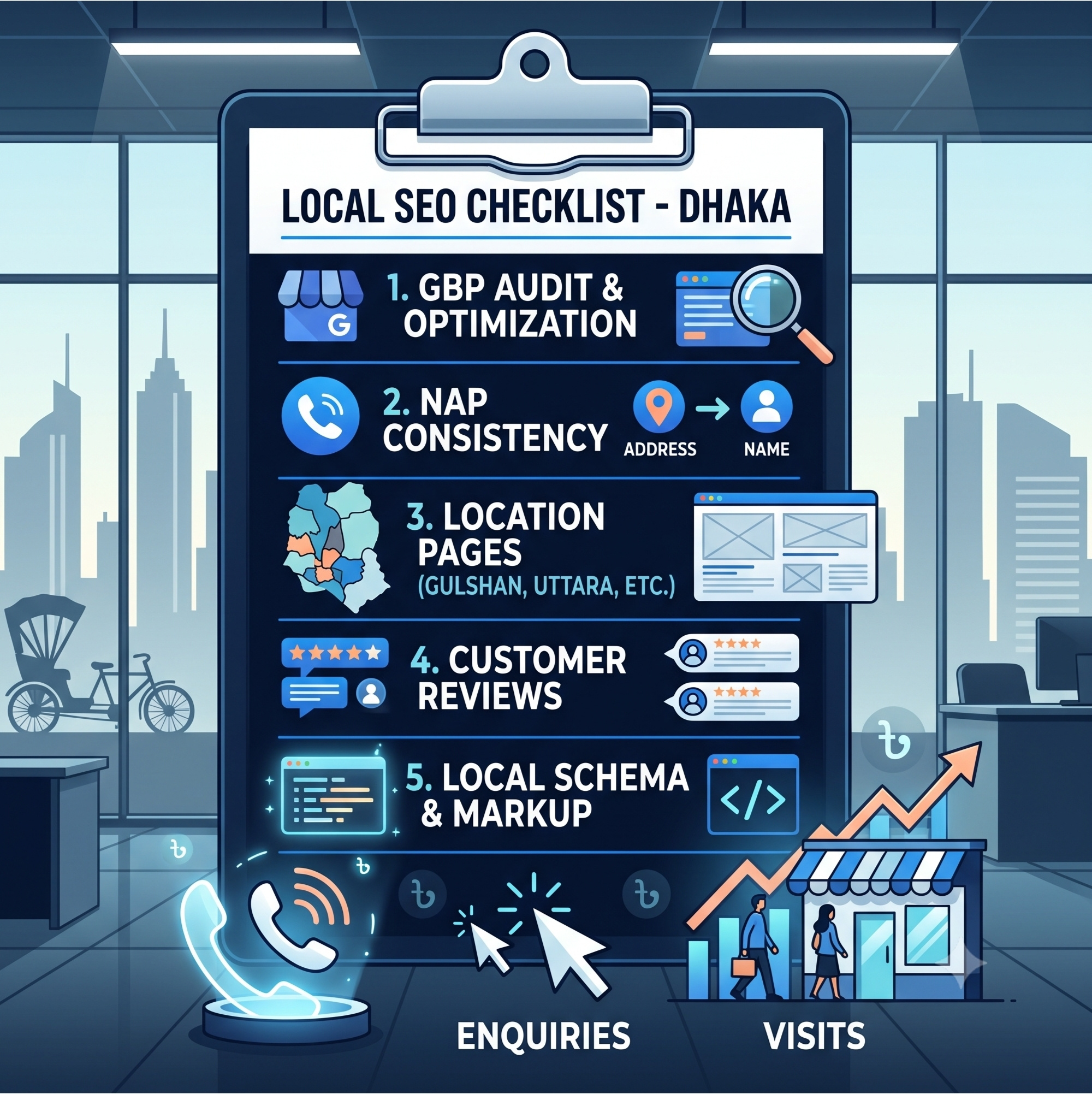
1. Define Your Priority Locations and Business Goals
Begin by identifying the locations that have genuine commercial value.
A business may serve all of Dhaka but receive most of its profitable enquiries from Gulshan, Banani, Dhanmondi, Uttara or Motijheel. Another company may operate from one physical location while serving customers across Mohammadpur, Mirpur, Badda and Bashundhara.
Trying to target every neighbourhood immediately can weaken the strategy. The business should first determine which services are most profitable, where ideal customers are located and which actions should count as conversions.
A useful objective is more specific than “rank in Dhaka.” It may be to generate qualified consultation requests from businesses in Gulshan and Banani or increase appointment calls from residents within five kilometres of a clinic.
This clarity influences the Google Business Profile, website structure, content priorities and reporting system.
2. Audit Your Business Name, Address and Phone Number
Your business name, address and phone number are commonly referred to as NAP information.
These details should appear consistently across the website, Google Business Profile, social profiles, local directories and other business listings. Small differences can create confusion when they represent genuinely different information.
For example, a business should avoid using “Panthapath Signal” on one platform, “Panthapath” on another and a completely different nearby address elsewhere unless each version is accurate and intentionally used.
Create one approved business-information document containing:
- Official business name
- Complete address
- Primary phone number
- Website URL
- Business email
- Opening hours
- Service areas
- Short business description
- Primary and secondary categories
This document should become the reference for every future listing.
3. Claim and Verify Your Google Business Profile
A Google Business Profile is one of the most important assets in a local SEO campaign.
Claim the correct profile and complete the required verification process. Do not create another listing simply because login information for the original profile is unavailable. Duplicate profiles can divide reviews, create inconsistent information and confuse customers.
The profile should be owned through an email address controlled by the business. An agency may be added as a manager, but the company should retain permanent administrative access.
This follows a broader digital-asset principle: your organisation should retain ownership of its domain, website, analytics accounts, advertising platforms and business profiles.
4. Choose the Correct Primary Business Category
The primary category helps describe the company’s main service.
Choose the category that most closely represents the activity responsible for the majority of customer enquiries. A software-development company should not select a broad marketing category merely because it also provides promotional support. A dental clinic should not choose a general medical category when a more specific option accurately represents its services.
Secondary categories can be used for legitimate additional services, but they should not be added only to appear for unrelated searches.
Category selection should reflect the actual business model, website content and customer expectations.
5. Complete Every Important Profile Field
An incomplete profile provides fewer signals to customers and search engines.
Add the correct address or service area, telephone number, website, opening hours, services, products where appropriate and a clear business description. Upload an accurate logo, cover image and real photographs of the office, team, storefront or completed work.
The business description should explain what the company does, who it serves and where it operates. It should not be filled with repeated keywords or unsupported claims.
Opening hours also require regular maintenance. Incorrect hours can create a poor customer experience, especially during government holidays, Eid periods or temporary closures.
6. Configure Your Address or Service Area Correctly
A storefront business and a service-area business should not be configured in the same way.
A clinic, restaurant, retail shop or agency that welcomes clients at a staffed office may display its address. A service business operating from a private residence and visiting customers at their locations may need to hide the address and define legitimate service areas.
Service areas should represent locations the company can realistically support. Adding every city in Bangladesh does not create national authority and may reduce relevance.
A Dhaka-based repair company, for example, may prioritise Mirpur, Mohammadpur, Dhanmondi and nearby areas rather than claiming coverage across the entire country.
7. Connect the Profile to the Most Relevant Website Page
The website URL in the Google Business Profile should normally lead to the page that best represents the business location and primary offering.
For a single-location company, this may be the homepage when it clearly explains the services and address. For a company with multiple verified branches, each profile should normally connect to the relevant branch or location page.
Do not direct every profile to an unrelated generic page. The destination should confirm the same business information presented in the profile and provide a clear conversion path.
The page should include the company name, service description, location information, contact method and an obvious action such as calling, booking or requesting a quotation.
8. Build a Dedicated Dhaka Location Page
A company serving Dhaka should have a page designed around the needs of customers in Dhaka, especially when the main website targets a broader national market.
A useful Dhaka location page should explain the services available, customer types served, office or service-area details, contact information and local proof. It may include directions, nearby landmarks, customer testimonials and relevant case studies.
The page should not be a generic service description with “Dhaka” inserted repeatedly. It should demonstrate genuine local relevance.
For example, a B2B agency may discuss the needs of companies in commercial areas such as Gulshan, Banani, Motijheel and Panthapath. A home-service company may explain how appointments are scheduled across different residential areas.
9. Create Separate Area Pages Only When They Add Value
Businesses often create pages for Gulshan, Uttara, Dhanmondi, Mirpur and every other neighbourhood. This can work when each page contains genuinely useful and differentiated information.
It becomes ineffective when twenty pages use the same text with only the area name changed.
An individual area page should exist only when the business has a meaningful presence, substantial demand, a branch, area-specific service conditions or enough unique information to justify the page.
A strong page may include:
- Services available in that area
- Local response or delivery information
- Relevant projects or customers
- Nearby landmarks
- Area-specific FAQs
- Unique testimonials
- Directions or branch details
Thin and repetitive location pages can weaken overall website quality rather than improve it.
10. Optimise Page Titles, Headings and Copy for Local Intent
Important pages should clearly communicate both the service and location.
A page title such as “Corporate Accounting Services in Dhaka” is more specific than “Our Services.” The heading and body copy should then explain the service naturally without repeating the same keyword in every sentence.
Local modifiers may include Dhaka, a specific neighbourhood, “near me” intent or the type of customer being served.
The objective is to match how customers search while maintaining readable, professional copy. Location keywords should support the page’s purpose, not replace meaningful information.
11. Add Complete Contact and Location Information to the Website
Customers should not need to search through several pages to find the company’s phone number or location.
Place essential contact information in visible areas such as the contact page, footer and relevant location pages. The information should match the approved NAP format. The contact page should also provide practical details, including business hours, email address, map or directions and the types of enquiries the company accepts.
For B2B organisations, adding a consultation form can help qualify the enquiry. The form may request the company name, required service, current challenge and preferred contact method without creating unnecessary friction.
12. Implement Local Business Schema
Local business schema is structured information added to a website to help search engines interpret the organisation.
The appropriate markup may include the business name, address, telephone number, website, opening hours, logo, geographical information and social profiles. Schema should confirm information already visible on the website. It should not include fictional ratings, false locations or services the company does not provide.
The organisation type should also be as accurate as possible. A legal practice, medical clinic, professional service firm and retail shop may require different schema types.
Structured data supports clarity, but it does not replace strong content, reviews or a properly maintained Google Business Profile.
13. Build Accurate Local Citations
A local citation is an online reference to a business’s name, address, phone number or website.
Citations may appear in business directories, industry platforms, chamber listings, professional associations and other reputable local sources. Quality matters more than submitting the company to hundreds of unknown directories. Focus on platforms that are relevant to Bangladesh, Dhaka, the company’s industry or its target customers.
Every listing should use consistent information and link to the correct website page where possible.
Citation building should strengthen the business entity. It should not become an automated link-building campaign involving irrelevant websites.
14. Find and Correct Duplicate or Inaccurate Listings
Old addresses, former phone numbers and duplicate profiles can remain online long after a company changes its information.
Search for variations of the business name, telephone number and address. Review social profiles, business directories, map listings and older company pages. Where possible, update or remove inaccurate listings. Duplicate Google Business Profiles should be handled carefully so that valid reviews and ownership are not lost.
This audit is particularly important after an office relocation, rebranding, phone-number change or company-name update.
15. Develop a Consistent Customer Review Process
Reviews influence trust and can provide useful information to customers comparing local providers.
Create a simple process for requesting reviews from genuine customers after a completed service, purchase, appointment or successful project milestone. The request should be polite and should not pressure the customer to leave only a positive rating.
A business might send a review link through email, WhatsApp or a post-service message. Staff should understand when and how to make the request.
Avoid purchasing reviews, creating fake accounts or offering rewards in exchange for a specific rating. Artificial activity can damage credibility and create platform risk.
The objective is to build a steady pattern of authentic customer feedback.
16. Respond Professionally to Positive and Negative Reviews
Review responses demonstrate that the company pays attention to customer experience.
A positive response can acknowledge the customer and mention the relevant service naturally. A negative response should remain calm, avoid disclosing private information and invite the customer to continue the conversation through an appropriate support channel.
Do not use identical responses for every review. Personalised replies appear more genuine and can reinforce the company’s service standards.
Negative feedback should also be analysed internally. Repeated complaints about response time, communication or service quality may reveal an operational problem that SEO cannot solve.
17. Publish Content Around Local Customer Questions
Local content should address the questions customers ask before contacting the business.
A property company might publish guidance on buying commercial space in specific Dhaka areas. A corporate internet provider could compare connectivity requirements for offices in Gulshan and Motijheel. A digital agency could explain marketing costs, local SEO requirements or website-development decisions for Bangladesh businesses.
The content should support service pages rather than compete with them.
Commercial terms such as local SEO services in Bangladesh should normally target a service page. Informational terms such as local SEO checklist Dhaka, Google Business Profile optimisation or local citation management should support cluster articles.
This separation creates a clearer SEO silo and reduces the risk of multiple pages targeting the same search intent.
18. Earn Relevant Local Links and Mentions
Local authority can be strengthened through genuine relationships and mentions.
Possible opportunities include business associations, supplier websites, local events, industry publications, educational partnerships, sponsorships and collaborations with complementary companies.
A Dhaka agency might earn a mention from a client’s case study, professional association or technology partner. A clinic might be referenced by a health organisation or community initiative.
The purpose is not to obtain any available link. The link or mention should make sense to users and reflect a real business relationship.
Avoid large packages promising hundreds of local backlinks. Relevance, editorial quality and legitimacy matter more than quantity.
19. Improve Mobile Experience and Local Conversions
Many local searches occur when the user wants to take immediate action. A slow or confusing mobile website can waste that demand.
Important pages should load efficiently, display correctly across devices and make contact options easy to find. Phone numbers should be clickable, forms should be short and directions should be accessible.
The message on the page should also match the search. A user looking for an emergency repair service requires immediate availability information. A B2B decision-maker looking for a software partner may need case studies, technical capabilities and a consultation form.
Before investing in more visibility, confirm that the website can turn local visitors into measurable enquiries.
20. Track Calls, Forms, Directions and Local Rankings
Local SEO should be measured by business outcomes.
Track calls, contact-form submissions, appointment bookings, messages and other relevant actions. Google Business Profile performance, website analytics and Search Console data can provide different parts of the picture.
Use consistent campaign parameters where appropriate to distinguish traffic from the Google Business Profile, social platforms, location pages and other sources.
Reporting should explain:
Measurement Business Question Calls Are local searches generating direct enquiries? Form submissions Which location pages produce qualified leads? Direction requests Is the profile generating physical visits? Search queries What services and locations are customers searching for? Conversion rate Does local traffic take meaningful action? Lead quality Are enquiries relevant, affordable and serviceable? Revenue contribution Does local SEO support profitable customers?
Rankings provide useful context, but ranking for an irrelevant local keyword does not create business value.
A 90-Day Local SEO Implementation Plan
Businesses do not need to complete every improvement on the same day. The work should be prioritised according to risk and potential impact.
Days 1–30: Establish Accuracy and Ownership
The first month should focus on verifying the Google Business Profile, confirming account ownership, auditing NAP information and reviewing the website’s local pages.
Tracking should also be checked before major changes begin. Without a baseline, it becomes difficult to prove whether calls, enquiries and visibility have improved.
Days 31–60: Strengthen Relevance and Trust
The second month should focus on profile completion, service descriptions, page optimisation, local schema, citation corrections and review acquisition.
Weak or missing location pages can be improved during this period. Duplicate listings should also be investigated.
Days 61–90: Build Authority and Improve Conversion
The third month should use the initial data to identify stronger queries, areas and services.
The business can then publish supporting local content, pursue relevant partnerships, improve underperforming landing pages and refine the review process.
At the end of the period, reporting should explain what was completed, what changed and which opportunities deserve priority during the next quarter.
Common Local SEO Mistakes in Dhaka
One common mistake is creating a Google Business Profile and then ignoring it. Hours, photographs, services, contact information and customer reviews require continued management.
Another mistake is producing dozens of nearly identical area pages. A page for Mirpur should contain more than the same paragraph used on the Dhanmondi page with one word replaced.
Businesses also lose trust when addresses and phone numbers differ across the internet. This often happens after relocation or when different employees create listings without a standard information document.
Finally, many companies measure local SEO only through ranking screenshots. A useful campaign should connect visibility with calls, enquiries, appointments and revenue.
How Kaizen Digital Hub Approaches Local SEO
Kaizen Digital Hub begins with the business objective, target locations and customer journey.
The first priority is understanding which services should generate enquiries and where the ideal customers are located. The team can then review the Google Business Profile, website structure, location signals, citations, reviews and tracking system.
A local campaign may require profile optimisation and citation corrections. Another business may need new location pages, website development, content and conversion tracking before additional visibility becomes valuable.
Kaizen does not treat every Dhaka business as the same project. A professional service company in Motijheel has different customers and conversion paths from a restaurant in Dhanmondi or a home-service provider covering Mirpur and Uttara.
Businesses seeking stronger map and local search visibility can explore Kaizen Digital Hub’s local SEO services in Bangladesh.
Final Local SEO Checklist
Before considering the campaign ready, confirm that the business has:
- Defined its most valuable services and Dhaka locations.
- Standardised its name, address and phone number.
- Claimed and verified the correct Google Business Profile.
- Selected accurate business categories.
- Completed all important profile fields.
- Configured its address or service areas correctly.
- Connected the profile to a relevant website page.
- Created a useful Dhaka location page.
- Built only genuinely valuable area pages.
- Optimised titles, headings and copy for local intent.
- Displayed complete contact information.
- Implemented accurate local business schema.
- Built relevant and consistent citations.
- Corrected duplicate and outdated listings.
- Established a genuine review-request process.
- Responded professionally to customer reviews.
- Published content around local customer questions.
- Earned legitimate local links and mentions.
- Improved mobile usability and conversion paths.
- Tracked leads, calls, visits and revenue contribution.
Completing this checklist creates a stronger local search foundation, but continued monitoring is still necessary. Competitors change, customer behaviour evolves and business information can become outdated.
Request a Local SEO Audit from Kaizen Digital Hub to identify issues affecting your Google Business Profile, local rankings, citations, location pages and lead tracking.
Frequently Asked Questions
What is local SEO?
Local SEO is the process of improving a business’s visibility for searches connected to a particular location. It can influence appearances in Google Maps, local results and standard organic listings.
How long does local SEO take in Dhaka?
The timeline depends on competition, website condition, profile history, location relevance and the amount of work required. Technical corrections and profile updates may be completed quickly, while stronger visibility and lead growth generally require continued optimisation.
Does every Dhaka business need location pages?
Not necessarily. A business should create a location page when it has genuine information and commercial relevance for that area. Creating many repetitive pages can weaken website quality.
Are Google reviews important for local SEO?
Reviews support customer trust and provide information about the business. A steady flow of genuine reviews is more valuable than a sudden pattern of artificial or purchased feedback.
What does NAP consistency mean?
NAP consistency means using the same accurate business name, address and phone number across the website, Google Business Profile, social profiles and reputable business directories.
Can a service-area business rank without showing its address?
A legitimate service-area business can configure its Google Business Profile around the areas it serves. Its website should still provide clear business information, services, contact options and evidence of local relevance.
Should I hire an agency for local SEO?
An agency may be useful when the project involves profile optimisation, citation management, location content, technical SEO, schema, development and conversion tracking. Before hiring, review the agency’s process, account-ownership policy and reporting standards.